
The magic of 'Not Yet' ✨
Geeking out about my favorite book.

Hey friend,
Have I told you recently that I love….
… the book Mindset by Carol Dweck, Ph.D?
Well….. ⤵️

I think this book — or at the very least, this concept — should be required reading for all humans at a young age.
Mindset explores why some people “succeed” (whatever success is to them) — and why some people don’t.
Researching many of the world’s highest performers across business, art, sports, academics + beyond, she identified that all of us gravitate toward one mindset or the other: a Growth Mindset or a Fixed Mindset.
In plain English, someone with a Growth Mindset believes that intelligence, personality, and capabilities are things that we can develop as a result of showing up and putting in the work. Someone with a Fixed Mindset believes that intelligence, talents and capabilities are fixed – you’re born with them or you’re not.
And simply put, the one thing that all the highest achievers in the world – the people who embody what we think of as SUCCESS – the people who do what they set out to do and at a high level – these people ALL have a GROWTH Mindset.
And while we all tend to lean more heavily toward one or the other – we have more of a Fixed Mindset or more of a Growth Mindset — although with effort and intention we can shift our mindset.
You’ve probably heard about how Michael Jordan, one of the best basketball players in history, was cut from his high school varsity basketball team. But instead of quitting all together, he used this as fuel. He worked HARD – day after day – and honed his skills and talents through hard work and dedication. And that hard work and effort is the greatest determinator of his success – NOT his natural talent.
To be clear, there are of course other things that factor into the success we experience. Natural proclivities, of course. And in the case of basketball – things like height and build certainly help.
But the number one factor that affects success is not the things we’re born with – it’s our beliefs around how skills and talents and capabilities are fostered.
One of the hallmark traits of a Fixed Mindset is the belief that things like intelligence and capability are innate — that we’re either born with them or we’re not. As a result, people with a Fixed Mindset tend to be very concerned with appearances. They want to look smart and capable, and are very afraid of making mistakes in public because they worry about being judged by others as unintelligent or untalented. Things that they don’t believe can be changed.
Here’s a great graphic about the two mindsets that I think illustrates some of the differences so beautifully.
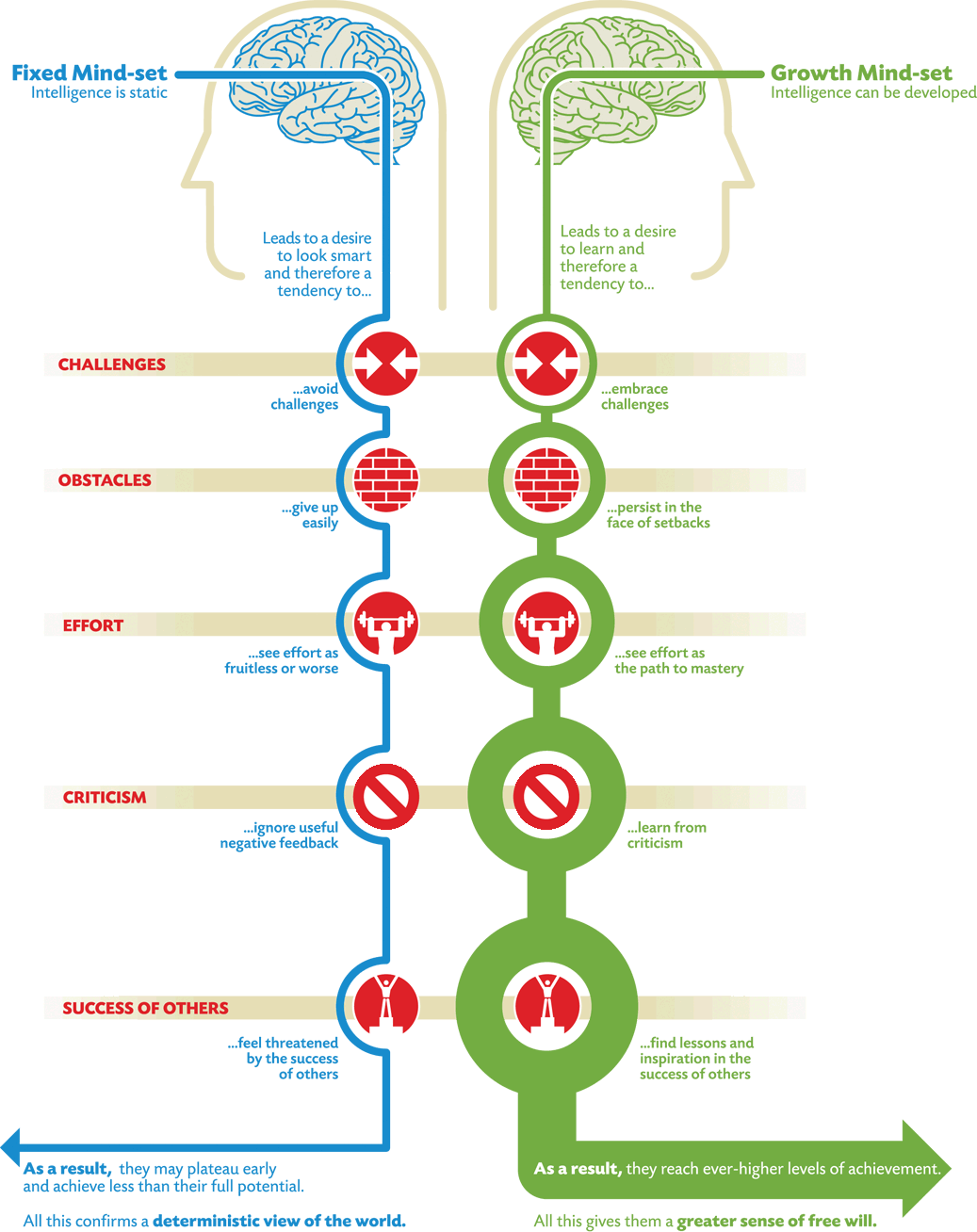
Graphic by Nigel Holmes (from here)
The Fixed Mindset
On the left hand side, we look at those with a Fixed Mindset: those who believe that intelligence is static. They avoid challenging things that they might fail at. They give up easily because they feel like they’re either good or they’re not. They see effort as useless (“I should be good at this naturally”), they are very resistant to feedback, and they tend to feel threatened by the success of others.
Because of this way of approaching life and work, they often don’t achieve their potential.
Here’s what Dweck says about these people:
If you have only a certain amount of intelligence, a certain personality, and a certain moral character— well, then you’d better prove that you have a healthy dose of them. It simply wouldn’t do to look or feel deficient in these most basic characteristics.
[…]
I’ve seen so many people with this one consuming goal of proving themselves— in the classroom, in their careers, and in their relationships. Every situation calls for a confirmation of their intelligence, personality, or character. Every situation is evaluated: Will I succeed or fail? Will I look smart or dumb? Will I be accepted or rejected? Will I feel like a winner or a loser?
The Growth Mindset
On the other hand, we have people with a Growth Mindset – who believe that intelligence and capability are developed through EFFORT.
People with a Growth Mindset embrace challenges because they know it’s a way of learning. They persist when they meet obstacles and they see effort as THE THING that helps them get better and better. They learn from criticism and view other people’s success as examples of what’s possible. Because of this approach, and this willingness to make mistakes and put in effort on their path to growth, they are constantly achieving more and more success.
About the Growth Mindset, Dweck writes:
There’s another mindset in which these traits are not simply a hand you’re dealt and have to live with, always trying to convince yourself and others that you have a royal flush when you’re secretly worried it’s a pair of tens. In this mindset, the hand you’re dealt is just the starting point for development. This growth mindset is based on the belief that your basic qualities are things you can cultivate through your efforts.
Why hide deficiencies instead of overcoming them? Why look for friends or partners who will just shore up your self-esteem instead of ones who will also challenge you to grow? And why seek out the tried and true, instead of experiences that will stretch you? The passion for stretching yourself and sticking to it, even (or especially) when it’s not going well, is the hallmark of the growth mindset. This is the mindset that allows people to thrive during some of the most challenging times in their lives.
My natural mindset
When I read this book, I was struck by the fact that my natural mindset for most of my life has, unfortunately more of a Fixed Mindset. Growing up, I hated putting myself out there publicly in case I was failed. When I didn’t make the Varsity team, I quit. I was naturally pretty good at school, but I often put in the bare minimum of effort because I liked the idea that I was “naturally” smart – and if I didn’t do well on something, I could always say, well, I didn’t even study. I found the process of applying for and getting rejected by some of the colleges I applied for EXCRUCIATING.
And while it would probably surprise many people to hear this, my lowest grade in college was my art class (funny I have an art-based business now!). After receiving that grade I didn’t take a single other art class and stuck with things I felt more naturally good at (funnily enough, for me that was Economics).
I can think of so so so many examples of my Fixed Mindset in action and how that held me back from even TRYING things.
Switching mindsets
It wasn’t until I quit my corporate career and started pursuing what genuinely interested me, that I really felt like I became GREAT at something. And now, about 5 years into business, I see over and over again that the things I’m the best at and see the best results in… are the things I’m willing to show up for! The things I’m willing to do even when I’m not good at them, and put the effort in, because I know that that’s how I get better.
Things I started out having no idea what I was doing:
Watercolor
Calligraphy
Launching
Hosting a me membership
Podcasting
SO MANY of my favorite things that I do now.
With all of these things, I had no natural talent — I’ve simply put in the effort to do them over and over again. I’ve messed up – often times in public. I’ve learned a ton. I’ve made mistakes. And that has been what’s made me see some success with these things.
So, my encouragement to you today is to ask yourself if you resonate more strongly with having a Fixed Mindset or a Growth Mindset? Do you tend to believe that intelligence and abilities are something you’re born with? Or do you believe that we can all be great through hard work and effort?
Here’s a quote from a TED Talk (The Power of Believing You Can Improve) that Carol Dweck gave that I think is the perfect way to wrap up this episode:
I heard about a high school in Chicago where students had to pass a certain number of courses to graduate, and if they didn’t pass a course, they got the grade “Not Yet.” And I thought that was fantastic, because if you get a failing grade, you think, I’m nothing, I’m nowhere. But if you get the grade “Not Yet” you understand that you’re on a learning curve. It gives you a path into the future.
I love love LOVE this concept of "not yet… and the idea of dividing our skills and abilities into two camps:
Skills, talents, intelligence that we have, and
Skills, talents, competencies that we don’t have… YET
So. My encouragement to myself (and you!) is to approach life with a “not yet” perspective, instead of a “pass/fail” or “win/lose” attitude.
Thanks for letting me geek out on one of my fave books. If you haven’t read Mindset by Carol Dweck yet – do yourself the favor of reading this book. It’s a amaaaaazing!
Cheering you on,
Lauren
Self-belief and putting in some work to improve, evolve, embrace challenges, etc, is so worth the effort, without killing ourselves and working too hard either!